Savannah Senior Advisor
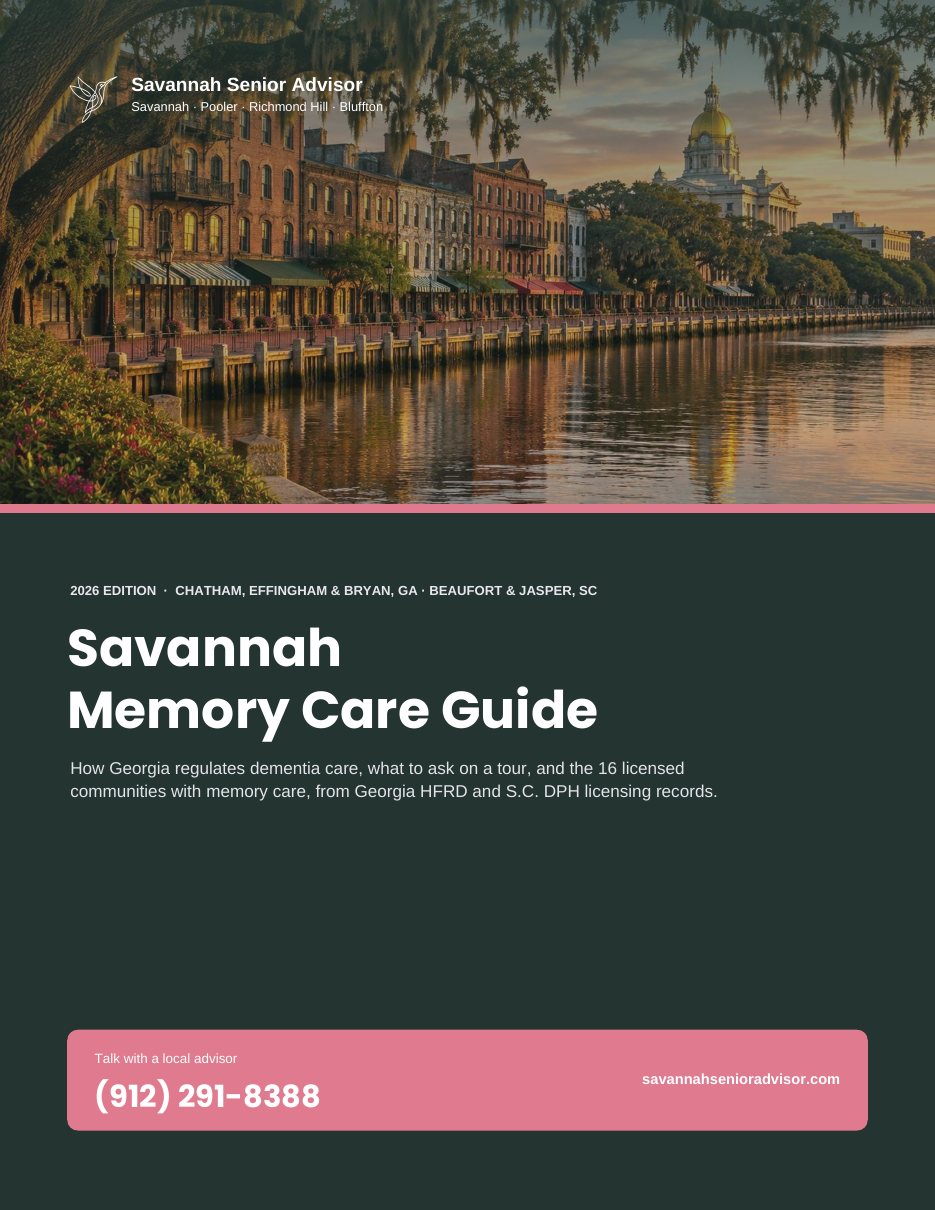
PDF (6 pages). Licensing data current to November 15, 2026.
What is in the Savannah Memory Care Guide?
What the PDF covers:
- When assisted living is enough and when a secured setting is safer.
- What Georgia requires of a community that serves residents with dementia, with the rule citations.
- 16 licensed communities in the Savannah metro (Chatham, Effingham, Bryan, Beaufort and Jasper counties) identified as offering memory care, with 1,244 licensed beds.
- How memory care pricing compares with the Georgia assisted living median.
- A printable checklist for memory care tours.
How is memory care different from assisted living in Georgia?
In Georgia, memory care is assisted living organized around dementia: a secured setting, caregivers with dementia training, and a structured day.
| Assisted living | Memory care | |
|---|---|---|
| Typical resident | Needs a hand with bathing, dressing or medications | Has a dementia diagnosis and needs supervision |
| Building | Open floor plan, residents leave freely | Locked or alarmed exits, enclosed outdoor space |
| Caregivers | Trained for daily-living help | Trained for memory loss and behavior changes |
| Monthly cost | Lower base rates | Higher, for staffing and security |
How does Georgia regulate memory care?
Georgia is one of the few states that certifies memory care. Since July 1, 2021 any unit in a personal care home or assisted living community that advertises or charges for specialized dementia care needs a Memory Care Center certificate, with its own ratios and training. South Carolina relies on DPH's Alzheimer's unit flag and a written disclosure instead.
- Certificate (GA). A DCH Memory Care Center certificate for any unit marketing or billing for dementia care.
- Staffing (GA). Dementia-trained aides at 1 per 12 residents awake and 1 per 15 overnight, monthly average.
- Training (GA). Four hours of orientation for all staff; 16 hours for direct care staff, then 8 hours yearly.
- South Carolina. An Alzheimer's special care unit flag plus a written program disclosure; general CRCF staffing applies.
How many the Savannah metro (Chatham, Effingham, Bryan, Beaufort and Jasper counties) communities offer memory care?
Georgia buildings of 16+ beds whose own HFRD reports document a memory care unit, and South Carolina CRCFs flagged by DPH for an Alzheimer's special care unit, 16 licensed communities in the Savannah metro (Chatham, Effingham, Bryan, Beaufort and Jasper counties) offer memory care, with 1,244 licensed beds between them.
Most are in Savannah, GA (7), Bluffton, SC (3), Pooler, GA (2) and Beaufort, SC (1). 0 of them are small settings licensed for 10 beds or fewer.
What does memory care cost in Georgia?
No state survey publishes a memory care median for Georgia or South Carolina. Savannah-area units usually quote a premium above the building's assisted living rate; ask for a single written monthly total including care fees.
What should I ask on a memory care tour in Savannah?
Go at the end of the day, when the unit is at its busiest, and bring these questions:
- What did your last state inspection find?
- Can residents keep their own doctor?
- Is the rate all-inclusive, or base plus care levels?
- How do residents get outdoors safely?
- How do you work with hospice?
Who stands up for a memory care resident in coastal Georgia?
The long-term care ombudsman program, reached through the Coastal Georgia Area Agency on Aging, visits personal care homes, assisted living communities and nursing homes and helps residents and families with concerns about care, rights and discharges. Rule violations go to HFRD's Complaint Intake Unit at (800) 878-6442, and suspected abuse to Adult Protective Services at 1-866-552-4464 (option 3).
Short on time?
Openings in secured memory care change week to week; an advisor can check them for you.
(912) 291-8388More free downloads
Who publishes this guide, and how is it paid for?
Savannah Senior Advisor writes and pays for it. We are a local placement and referral service, so our income is a referral fee from the provider a family chooses, never a charge to the family.
Nobody bought a spot in the guide. Its lists are drawn from the Georgia DCH Healthcare Facility Regulation Division (HFRD) and the S.C. Department of Public Health (DPH) record, and it is general information rather than medical, legal or financial advice.